I repeated the three liquid stack demonstration described in an earlier post (http://blog.gerstein.info/2017/04/fun-things-about-liquids-illustrated-by.html).
Based on doing it again, here are some pointers:
(1) It is good to put the honey in first because it takes such a long time to get into the bottle.
(2) The best thing for each layer is putting the coins on the bottom, followed by pasta noodles at the honey water interface, blueberries at the oil-water interface, and, finally, cork at the very top.
There are several other toys that can be coupled with this demonstration.
(A) The Ooze tube (https://www.amazon.com/dp/B015TAH9S6) can act as a timer to indicate resistance to flow very well in the honey oil situation.
(B) Moreover, one can use a hand boiler (https://www.amazon.com/TEDCO-502-Hand-Boiler/dp/B008J4DOAM), which has alcohol, to demonstrate other aspects of liquids such as boiling; this isn't evident in the three liquid stack.
(C) Finally, one could perform a circuit demonstration, using a "Sci-Fi Sensor Stick" (https://www.amazon.com/dp/B07H7B1L41)
This is a lot of fun and shows flow in another type of liquid -- in the sense of electrons flowing through a circuit, which is somewhat connected to the flow of liquids.
==
See also
https://linkstream2.gerstein.info/tag/toys0mg
Showing posts with label fun. Show all posts
Showing posts with label fun. Show all posts
Saturday, December 28, 2019

Sunday, April 23, 2017
Fun things about liquids illustrated by simple kitchen mixtures of oil & water: hydrophobicity, diffusion, surface tension, &c
I did my PhD partially on liquids, analyzing the hydrophobic effect. Recently, I stumbled across an account describing simple things that you can do with home kitchen ingredients to illustrate properties of water and other liquids (see reference at bottom). The basic idea, of course, is just to mix oil and water in a container. However, there are many flourishes that you can easily add - for instance, you can add syrup (a very thick liquid) at the bottom, which forms a third layer separated to some degree from the water unless you vigorously mix it.
You can then put lots of things into this three-layer stack that go to the different characteristic layers depending upon the density -- for example, corks or toothpicks, which float to the very top, or blueberries, raspberries and some other vegetables, which go to the oil-water interface. Then there are things such as light plastic beads and pasta that go to the water-syrup layer. Finally, coins or metal objects sink to the bottom. Tightly crumpled paper vs a flat piece will also go to different levels, illustrating Archimedes'.
There are other neat things you can do such as pouring little bits of dye into the mixture and then watching it go through the oil and slowly mix with the water. Or even putting small amounts of salt in and watching them clump together and eventually pass through the oil before dissolving into the water. The differential aspects of pouring and mixing illustrate the physical concepts of diffusion and viscosity.
To some degree, one can also see the differences in surface tension of water and oil when one looks at objects at the oil/water boundary and also floating on top of the oil. The surface tension of the water is illustrated by the curved shape of the oil/water boundary (where the blueberry sits) in contrast to the top of the stack on the oil (where the cork or the duck sits).
Finally, if one leaves the preparation for enough time, the syrup mixes with the water. Of course, the oil and the water will stay separate. Eventually, if you wait long enough, you will see a small layer of bacteria at the interface, which is kind of interesting to watch grow, presumably getting considerable energy from the hydrocarbons in the oil.
Altogether a lot of fun: I have taken many pictures of the mixing and so forth and I would encourage people to do the same at home.
https://www.YouTube.com/playlist?list=PLG7nfiaFnr-OgodysasPGwH_6px430LVn and https://www.flickr.com/photos/mbgmbg/albums/72157679876202931
Time-lapses: at first fast; then slow to equilibrium
Density
Viscosity and diffusion
Capillary Action and Surface Tension
Hydrophobic Effect
Archimedes' principle
You can then put lots of things into this three-layer stack that go to the different characteristic layers depending upon the density -- for example, corks or toothpicks, which float to the very top, or blueberries, raspberries and some other vegetables, which go to the oil-water interface. Then there are things such as light plastic beads and pasta that go to the water-syrup layer. Finally, coins or metal objects sink to the bottom. Tightly crumpled paper vs a flat piece will also go to different levels, illustrating Archimedes'.
There are other neat things you can do such as pouring little bits of dye into the mixture and then watching it go through the oil and slowly mix with the water. Or even putting small amounts of salt in and watching them clump together and eventually pass through the oil before dissolving into the water. The differential aspects of pouring and mixing illustrate the physical concepts of diffusion and viscosity.
To some degree, one can also see the differences in surface tension of water and oil when one looks at objects at the oil/water boundary and also floating on top of the oil. The surface tension of the water is illustrated by the curved shape of the oil/water boundary (where the blueberry sits) in contrast to the top of the stack on the oil (where the cork or the duck sits).
Finally, if one leaves the preparation for enough time, the syrup mixes with the water. Of course, the oil and the water will stay separate. Eventually, if you wait long enough, you will see a small layer of bacteria at the interface, which is kind of interesting to watch grow, presumably getting considerable energy from the hydrocarbons in the oil.
Altogether a lot of fun: I have taken many pictures of the mixing and so forth and I would encourage people to do the same at home.
Pictures and Movies of the oil-water separation
Playful Separations: photos of oil-water mixtures in bottles, some with a 3rd layer and suspended objects (https://www.flickr.com/photos/mbgmbg/tags/seriesimscientist0mg2)https://www.YouTube.com/playlist?list=PLG7nfiaFnr-OgodysasPGwH_6px430LVn and https://www.flickr.com/photos/mbgmbg/albums/72157679876202931
Time-lapses: at first fast; then slow to equilibrium
Related Post
http://blog.gerstein.info/2015/11/q-why-does-lemon-seed-in-sparkling.htmlMy Tags
imascientist, imascientist, iamascientist, imascientist0mg, imascientist0mg2, imscientist0mg2Reference
Lisa Burke, http://www.amazon.com/Im-Scientist-Kitchen-DK-Publishing/dp/0756663075Things illustrated
Diffusion and viscosityDensity
Viscosity and diffusion
Capillary Action and Surface Tension
Hydrophobic Effect
Archimedes' principle
Sunday, November 22, 2015
Q: Why does a Lemon Seed in Sparkling Water Oscillate Up & Down?
I am creating this post to ask a question. In the below links I have made a movie of a cut lemon in a glass of sparkling water.
https://goo.gl/photos/pcWp4s8P4PPjvaCx9
(1st version is full-sized & normal speed; 2nd, sped up; 3rd, reduced size [6Mb].)
One thing that intrigues me is that the seed associated with the lemon seems to oscillate up and down in the water, alternatively going down and coming up. Why is this? Is it due to accumulation of bubbles beneath the seed at the bottom, and then dissipation at the top? Or some other phenomena? If anyone has the answer I would appreciate hearing your response either via social media or email.
Lemon-seed-moving-up-n-down-in-sparkling-water-1min-41Mb-540p.mov
Lemon-seed-moving-up-n-down-in-sparkling-water-8x-8s-850Kb.mov
Lemon-seed-moving-up-n-down-in-sparkling-water-1min-6Mb.mov
Wednesday, January 04, 2012
What Google knows about me.... I'm 30!
What Google knows about me on its "Ad Preferences" Page is shown below. The company appears to think I'm in the 25 to 34 demographic! Wow - kind of a compliment.
Ads on the web
Ads on the web
Make the ads you see on the web more interesting
Many websites, such as news sites and blogs, partner with us to show ads to their visitors. To see ads that are more related to you and your interests, edit the categories below, which are based on sites you have recently visited. Learn More
Your interests are associated with an advertising cookie that's stored in your browser. If you don't want us to store your interests, you can opt out below. Your ads preferences only apply in this browser on this computer. They are reset if you delete your browser's cookies.
Your interests are associated with an advertising cookie that's stored in your browser. If you don't want us to store your interests, you can opt out below. Your ads preferences only apply in this browser on this computer. They are reset if you delete your browser's cookies.
Watch a video: Ads Preferences on GDN explained
Your categories
Below you can review the interests and inferred demographics that Google has associated with your cookie. You can remove or edit these at any time.
Computers & Electronics - Software - Business & Productivity Software
Computers & Electronics - Software - Operating Systems - Mac OS
Internet & Telecom - Web Services - Web Design & Development
Internet & Telecom - Web Services - Web Hosting & Domain Registration
Jobs & Education - Education - Colleges & Universities
Online Communities - Photo & Video Sharing - Photo & Image Sharing
Online Communities - Social Networks
Science - Biological Sciences
Science - Engineering & Technology - Robotics
Travel - Car Rental & Taxi Services
Your demographics
We infer your age and gender based on the websites you've visited. You can remove or edit these at any time.
Age: 25-34
Gender: Male
Thursday, January 27, 2011
Word Cloud of this Blog
article assembly associated aug bond book celera clipbookgoodreadafterjan07 com dec delicious discussion etf feb flickr funds genome http index interesting inv jan jpg labels life litchfield lots maps market mbgmbg nature nice notes nov oct original permalink picasa related science scinatpoddec10 scinatpodfall0mg sept sequence shot stock thoughts total trip www
created at TagCrowd.com
Saturday, March 20, 2010
My academic genealogy, back to Newton !
Link to the Mathematics Genealogy Project
Image of my academic genealogy back to Newton , with a mere 18 links ! (courtesy of C Chothia)
Text of the above (18 links to Newton)
Image of my academic genealogy back to Newton , with a mere 18 links ! (courtesy of C Chothia)
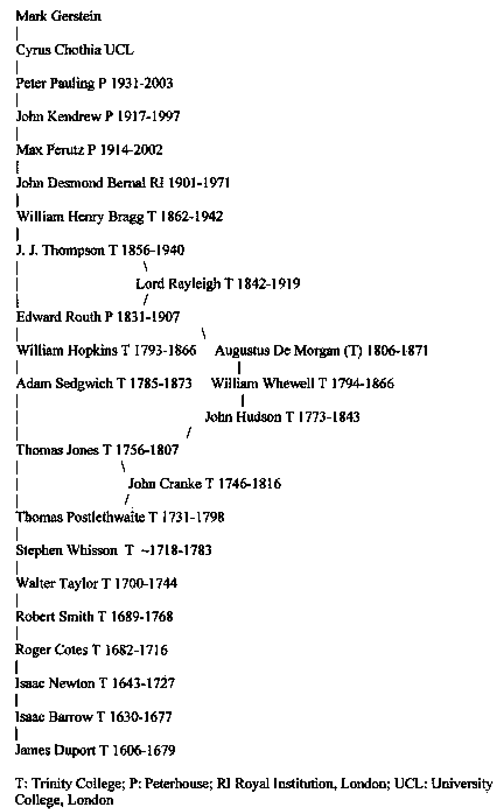
Text of the above (18 links to Newton)
**1.** Mark Gerstein
2. Cyrus Chothia UCL (+ R Lynden Bell)
3. Peter Pauling P 1931-2003
4. John Kendrew P 1917-1997
5. Max Perutz P 1914-2002
6. John Desmond Bernal RI 1901-1971
7. William Henry Bragg T 1862-1942
8. J. J. Thompson T 1856-1940
- - - I Lord Rayleigh T 1842-1919
9. Edward Routh P 1831-1907
10. William Hopkins T 1793-1866
- - -Augustus De Morgan (T) 1806-1871
11. Adam Sedgwich T 1785-1873
- - - William Whewell T 1794-1866
- - - John Hudson T 1773-1843
12. Thomas Jones T 1756-1807
- - - John Cranke T 1746-1816
13. Thomas Postlethwaite T 1731-1798
14. Stephen Whisson T ~ 1718-1783
15. Walter Taylor T 1700-1744
16. Robert Smith T 1689-1768
17. Roger Cotes T 1682-1716
**18.** Isaac Newton T 1643-1727
Isaac Barrow T 1630-1677
James Duport T 1606-1679
T: Trinity College; P: Peterhouse; RI Royal Institution, London; UCL: University College, London
Saturday, January 16, 2010
Trips to Europe '09
Here I've collected various things related to some trips to Europe in 2009.
* Pictures
Flickr photos galleries from London in Jan., Belgium in Oct., and Paris & Cambridge in Dec. (The analogous links in picasa: London, Belgium, & Paris .)
In addition to the usual tourist shots, I took some fairly abstract photos and some more general "concept" ones. My photos also added significantly to my burgeoning McDonald's photo collection.
* Tags & Routes
I tagged my photos quite extensively. Here's a listing of some of my more commonly used tags on the trips. One 'tag group' that was particularly hard to shoot were the panoramas and nighttime photos , where I was aided by my trusty new Sony. Here's an almost 360' panorama of the Louvre.
As might be expected, I geotagged many of the photos as well; thus, each of these galleries is associated with a nice map link -- e.g. here's an one for Paris . The geotagging has the side benefit of providing some tracks of where I went, viz: walking around Paris, Paris to London (via Chunnel), & walking around London (not necessarily in order).
* Links & Lectures
Here's a general collection of links of random information associated with the trips.
Some lectures that I gave during the trips: 1a, 1b, 2, 3, 4
Some of my own cryptic internal IDs with yet more links: i0wtsysbio, i0gencwinter08, i0vib
Friday, November 28, 2008
Trip to Greece
Pictures
* Overall ~100 pictures of things in Greece, organized on Flickr and Picasa
http://www.flickr.com/photos/mbgmbg/sets/72157610294361788
http://picasaweb.google.com/bluehat/GreeceThings02 (map of this)
* Some nice subsets of the images
- Just of Santorini: http://www.flickr.com/photos/mbgmbg/tags/santorini
(Map of the above: http://www.flickr.com/photos/mbgmbg/tags/santorini/map)
- Visiting and looking at Parthenon
Some of the ruins in Greece were a bit beaten up (tag "ruinedruins")
- A particular specialization of the above is a focus on rather dynamic graffiti interposed with iconic architecture and well known sites. See tag "graffiti" and map of it. (This includes images in other locations than just Greece.)
- Some other fun tags to look at are "abstract" and "landscape"
(These include images in other locations.)
Collection of links
relevant to the trip (includes some useful guidebooks)
http://delicious.com/mbgmbg/fungreece
http://delicious.com/mbgmbg/funathens
Rough track
of walk up to Parthenon
Monday, October 06, 2008
Trip to Toronto (TripToronto + TripISMB08 + Fall08)
* Public shots of buildings and other stuff
http://picasaweb.google.com/bluehat/TripTorontoThings#
http://www.flickr.com/photos/mbgmbg/sets/72157607038288351/
* Some relevant links to fun stuff and things at the conference
http://delicious.com/mbgmbg/FunTripISMB08
http://delicious.com/mbgmbg/link_ismb08
http://delicious.com/mbgmbg/bioinfoconfmg
* Some Lectures that I gave:
http://lectures.gersteinlab.org/summary/ismb08pub-20080723-textmining
http://lectures.gersteinlab.org/summary/ISMB08-SS-20080721-Nets
http://lectures.gersteinlab.org/summary/ISMB08-SIG-20080721-GenomeTechAnnotate
http://lectures.gersteinlab.org/summary/ISCB-SC-20080718-motions
* Interesting quote
we should == I will
* Rough GPS track of a long Sunday Walk
http://maps.google.com/maps?q=http://gerstein.info/gps/TripISMB08-SunEdit.kmz
(Addendum)
Some more pictures from another visit in the fall
http://picasaweb.google.com/bluehat/AP20081109TorontoFallThings#
http://flickr.com/photos/mbgmbg/sets/72157610352978523
Sunday, January 07, 2007
Midnight Run Timings
| Lap | Wall clock | Delta | Time (min) | Mile | Minutes/mile |
| | 12:00:00 | 0:02:46 | 0:19:47 | 0 to 2 | 0:09:54 |
| 1 | 12:02:46 | 0:17:01 | |||
| 2 | 12:19:47 | 0:10:15 | 0:10:15 | 2 to 3 | 0:10:15 |
| 3 | 12:30:02 | 0:08:12 | 0:09:13 | 3 to 4 | 0:09:13 |
| | 12:38:14 | 0:01:01 | |||
| | 12:39:15 | | | | |
| | | | | | |
| Total | | 0:39:15 | | | |
Graphs of the times with heart rates are here
Tuesday, December 26, 2006
Oenology: Red wine procyanidins and vascular health -- Nature
American Culture’s French Connection -- NY Times
Why isn't there an AmericanCulture.org? The answer from France.
http://www.nytimes.com/2006/12/26/books/26martel.html?ex=157680000&en=a4db9732c27a057e&ei=5124&partner=permalink&exprod=permalink
http://www.nytimes.com/2006/12/26/books/26martel.html?ex=157680000&en=a4db9732c27a057e&ei=5124&partner=permalink&exprod=permalink
American Culture's French Connection
In "Culture in America," Frédéric Martel challenges the view that (French) culture financed by the government is good and that (American) culture shaped by market forces is bad.... Reviewing the book in Le Monde, Michel Guerrin and Emmanuel de Roux also said its strength lay in its emphasis on investigation over opinion. And another article in Le Monde took the American cultural statistics collected by Mr. Martel and compared them with similar figures for France. Its unexpected conclusion was that measured per capita the cultural infrastructures in the two countries were roughly similar... The first half of "Culture in America" — the title echoes Tocqueville's own "Democracy in America" — is built around a question that puzzles some French: Why doesn't the United States have a Culture Ministry?...He seemed to be looking forward to a fight. "That's why my book is about France," he said, "while being about America."
Subscribe to:
Posts (Atom)